HVAC Tax Credits & Rebates Guide (2026)
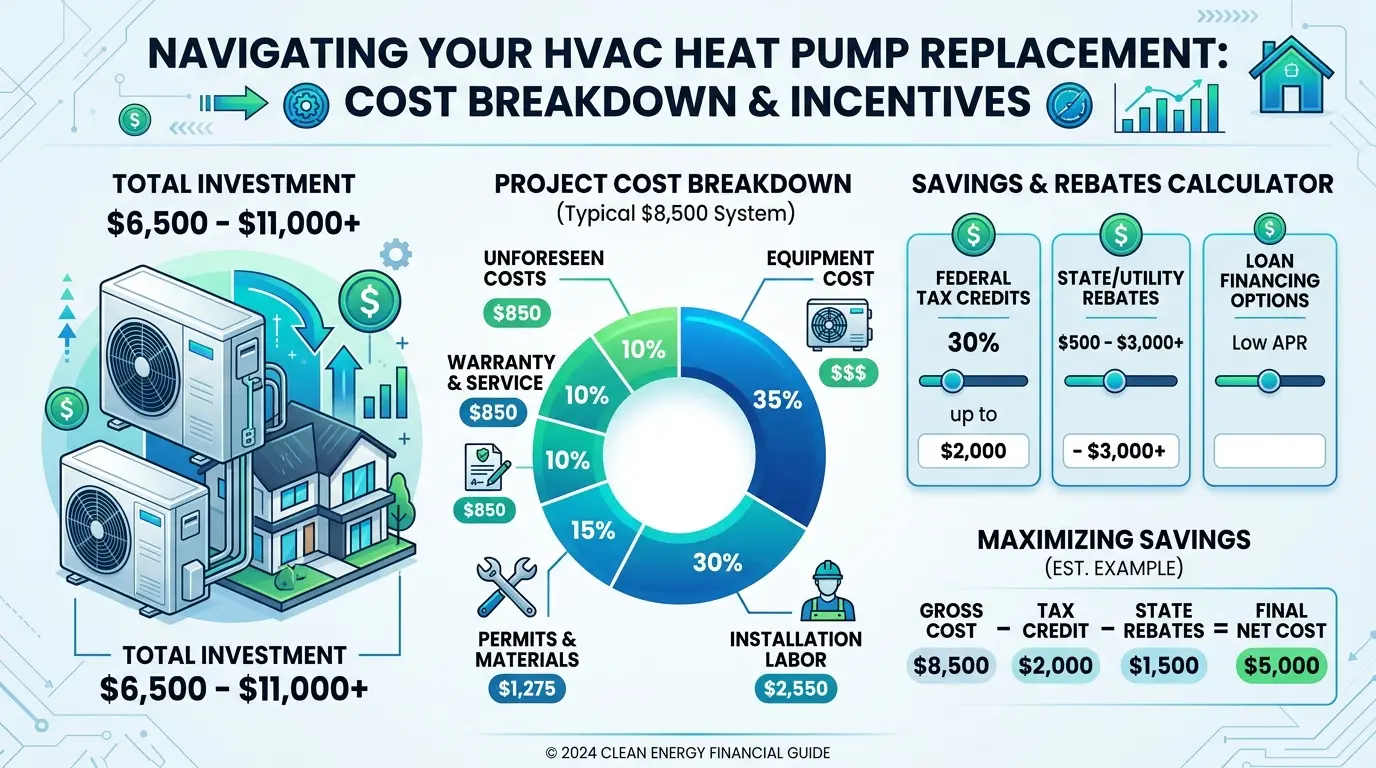
If you are wondering what hvac system qualifies for tax credit 2025, the answer includes air source heat pumps, central air conditioners, and natural gas furnaces that meet or exceed the Consortium for Energy Efficiency highest efficiency tier. According to ENERGY STAR and IRS.gov, qualifying heat pumps are eligible for a tax credit of up to $2,000, while eligible central air conditioners and furnaces can receive up to $600 in tax credits under the Energy Efficient Home Improvement Credit.
Homeowners upgrading their heating and cooling infrastructure have a unique opportunity to offset significant installation expenses through both federal incentives and local utility programs. The Inflation Reduction Act extended and expanded the Section 25C tax credits through 2032, allowing taxpayers to deduct a percentage of the total project cost for high efficiency HVAC equipment. By understanding the specific requirements outlined by the Department of Energy (DOE) and the Environmental Protection Agency (EPA), you can maximize your financial return on a new system.
Understanding the Energy Efficient Home Improvement Credit
The Energy Efficient Home Improvement Credit provides a financial incentive equal to 30 percent of the total installation and equipment costs for qualifying energy property. The IRS established annual limits for different categories of HVAC equipment. While the overall annual limit for most home improvements is capped at $1,200, there is a separate, higher annual limit of $2,000 specifically designated for qualified heat pumps and heat pump water heaters. You can claim both limits in the same year, meaning a comprehensive home energy upgrade could yield a total federal tax credit of $3,200.
To ensure eligibility, the installed equipment must be placed in service in your primary residence during the tax year. The residence must be an existing home located in the United States. New construction projects and rental properties do not qualify for this specific federal tax credit. Additionally, the equipment must meet the precise energy efficiency metrics established by the Consortium for Energy Efficiency (CEE) that are in effect at the start of the year the system is installed.
For more comprehensive data on what you can expect to spend before these incentives are applied, consult our HVAC system cost guide. Understanding the baseline costs will help you calculate your exact return on investment when factoring in a 30 percent tax credit and local utility rebates.
Detailed Requirements for Heat Pumps
Air source heat pumps represent the most heavily incentivized category of HVAC equipment due to their exceptional energy efficiency and reduced carbon footprint. To claim the maximum $2,000 tax credit, an air source heat pump must achieve the CEE highest efficiency tier. The specific metrics vary depending on whether the system is a ducted split system, a packaged system, or a ductless mini split.
For ducted split systems installed in the northern climate zone, the heat pump must typically boast a Seasonal Energy Efficiency Ratio (SEER2) of at least 15.2, an Energy Efficiency Ratio (EER2) of 10.0, and a Heating Seasonal Performance Factor (HSPF2) of 8.1. Southern climate zones have slightly different metric requirements focusing more heavily on cooling efficiency. According to the DOE, upgrading from a base model 14 SEER unit to a high efficiency 18 SEER2 heat pump can reduce your annual energy consumption by roughly 20 percent.
Consider a concrete numeric example. A homeowner purchases a qualified cold climate air source heat pump for $8,500, inclusive of labor and materials. Thirty percent of $8,500 is $2,550. Because the credit for heat pumps is capped at $2,000, the homeowner will receive a $2,000 reduction on their federal tax liability for that year. The remaining $6,500 represents the net cost, which can often be further reduced by local utility incentives.
Requirements for Air Conditioners and Furnaces
Central air conditioners and natural gas, propane, or oil furnaces are eligible for a maximum tax credit of $600 each. Like heat pumps, central air conditioning systems must meet the CEE highest efficiency tier. A standard split system air conditioner usually requires a SEER2 rating of 16.0 and an EER2 of 12.0 to qualify. Upgrading an obsolete air conditioner to a modern ENERGY STAR certified unit can yield substantial seasonal savings, especially in warmer climates where cooling loads are high.
For natural gas furnaces, the federal requirement mandates an Annual Fuel Utilization Efficiency (AFUE) rating of at least 97 percent. This means that 97 percent of the fuel consumed is converted directly into usable heat for the home, with only 3 percent escaping through the exhaust flue. Oil furnaces must reach an AFUE of at least 90 percent and must be approved for use with renewable fuel blends.
If you purchase a qualifying central air conditioner for $5,000 and a qualifying gas furnace for $4,000 at the same time, you can calculate 30 percent of each individual cost. Thirty percent of the air conditioner is $1,500, capped at the $600 limit. Thirty percent of the furnace is $1,200, also capped at $600. The total combined tax credit would be $1,200, representing the absolute maximum allowed under the general home envelope category.
Con Edison HVAC Rebates
Beyond federal incentives, utility companies offer significant localized rebates. For residents in New York, the con edison hvac rebates program provides aggressive financial support for transitioning away from fossil fuels and adopting high efficiency heat pump technology. These utility rebates are entirely separate from federal tax credits and can be stacked together to dramatically lower the upfront cost of equipment.
The Con Edison Clean Heat Program provides prescriptive rebates based on the heating capacity of the installed system. For instance, partial load air source heat pumps can often qualify for a rebate of $1,000 to $2,000, while whole home systems designed to completely replace an existing fossil fuel heating system can yield rebates ranging from $4,000 to over $8,000 depending on the total tonnage and thermal output. A 3 ton cold climate heat pump replacing a natural gas boiler might qualify for approximately $6,000 in upfront utility rebates.
These utility rebates are typically processed directly by a participating contractor at the point of sale. This means the homeowner does not need to wait until tax season to realize the savings. The contractor deducts the rebate amount from the final invoice and handles the necessary administrative paperwork with Con Edison. You must select a contractor who is registered with the Con Edison Clean Heat Network to ensure the equipment and the installation meet the strict program standards.
Comparing Tax Credits and Utility Rebates
Understanding the difference between a tax credit and a utility rebate allows you to strategically plan your HVAC replacement. A rebate is an upfront discount or a direct cash payment issued shortly after installation. A tax credit reduces the amount of income tax you owe to the federal government when you file your annual return. The table below outlines the primary differences and maximum limits for both incentive types.
| Incentive Type | Eligible Equipment | Maximum Amount | Application Method |
|---|---|---|---|
| Federal Tax Credit (Section 25C) | Air Source Heat Pumps | $2,000 (30% of cost) | Claimed on IRS Form 5695 |
| Federal Tax Credit (Section 25C) | Furnaces and Air Conditioners | $600 (30% of cost) | Claimed on IRS Form 5695 |
| Con Edison Clean Heat Rebate | Whole Home Heat Pump Systems | Varies heavily by tonnage ($4,000+) | Instant discount by participating contractor |
| Con Edison Clean Heat Rebate | Partial Load Heat Pumps | Typically $250 to $1,000 per outdoor unit | Instant discount by participating contractor |
Steps to Claim Your Financial Incentives
Securing these incentives requires careful documentation and proactive planning. Begin by consulting the Air Conditioning Contractors of America (ACCA) guidelines to ensure your selected contractor performs a proper Manual J load calculation. This calculation ensures the HVAC system is correctly sized for your specific floor plan. Oversized equipment will short cycle, reducing efficiency and potentially disqualifying the unit from performance based rebates.
Once you verify that the proposed system meets the CEE highest efficiency tier or the specific utility requirements, retain all documentation. You will need the manufacturer certification statement, the Air-Conditioning, Heating, and Refrigeration Institute (AHRI) certificate, and a detailed itemized invoice from your installation contractor. The invoice must clearly separate the equipment cost from any unrelated home repairs.
When filing your federal taxes, you must submit IRS Form 5695 alongside your standard return. This form requires you to input the exact cost of the eligible energy property and calculate the 30 percent credit. If your calculated credit exceeds your total tax liability for the year, you cannot carry the excess credit forward to the following tax year. Because tax laws and utility programs undergo regular revisions, always verify the current requirements on the ENERGY STAR website and your local utility portal before finalizing an installation contract.
Try Our Efficiency Payback Calculator
Calculate your net cost after tax credits and energy savings.
Open Efficiency Payback Calculator →