How Does HVAC Work? Step-by-Step Breakdown
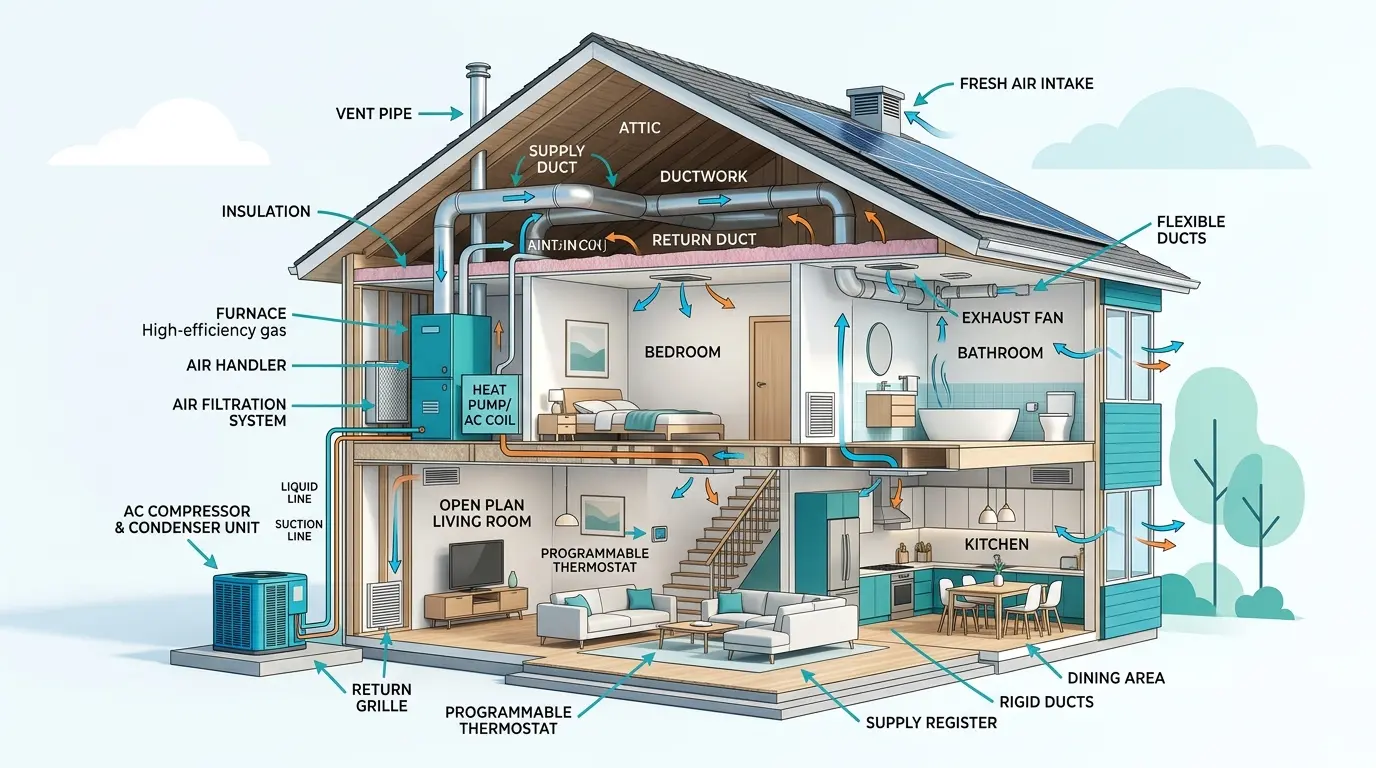
If you are wondering how does HVAC work, the answer relies on the fundamental principles of thermodynamics, fluid mechanics, and heat transfer. An HVAC system functions by moving heat from one location to another, either absorbing heat from inside your home and releasing it outdoors to cool the space, or capturing outdoor heat and transferring it indoors for warmth. This continuous cycle regulates temperature, controls indoor humidity, and ensures proper ventilation.
How Does a HVAC System Work?
To understand how does a HVAC system work, you must look at the refrigeration cycle and the air distribution system. A typical split system uses a closed loop of refrigerant that continuously changes state from liquid to gas. According to the Department of Energy (DOE), this phase change allows the system to absorb and reject heat efficiently. When the thermostat signals a need for cooling, the system pulls warm indoor air through return ducts, passes it over cold evaporator coils, and blows the conditioned air back through supply ducts.
For more details on different configurations, see our guide on HVAC system types explained.
How Do HVAC Systems Work During Winter?
When asking how do HVAC systems work when heating is required, the process depends on the fuel source. A furnace burns natural gas, propane, or oil to generate heat, which is then transferred to the air via a heat exchanger. A heat pump, on the other hand, reverses the cooling cycle. It extracts heat energy from the cold outside air and pumps it indoors. Modern heat pumps can operate effectively even when outside temperatures drop below freezing, sometimes down to 5 degrees Fahrenheit.
The Core Mechanics: How HVAC Works
The foundation of how HVAC works lies in temperature and pressure manipulation. By changing the pressure of the refrigerant, the system dictates its boiling point. In the indoor unit, the pressure is low, allowing the refrigerant to boil and absorb heat at room temperature. In the outdoor unit, the compressor raises the pressure, raising the boiling point and forcing the refrigerant to release heat into the hotter outdoor air.
How Does an HVAC Compressor Work?
Many homeowners ask how does an HVAC compressor work. The compressor is the engine of the air conditioning cycle. Located in the outdoor unit, it receives low pressure, low temperature refrigerant gas from the indoor evaporator coil. The compressor squeezes this gas, significantly increasing its temperature and pressure. This high pressure, high temperature gas then flows into the condenser coil, where it can successfully reject heat to the outside air, which might be 95 degrees Fahrenheit.
What is Delta T in HVAC?
What is delta T in HVAC? Delta T, or temperature differential, is the difference between the return air temperature entering the HVAC system and the supply air temperature leaving it. For a properly functioning air conditioning system, the ACCA (Air Conditioning Contractors of America) states that the delta T should typically fall between 18 and 22 degrees Fahrenheit. If your return air is 75 degrees, the supply air should be around 55 degrees. A delta T outside this range indicates potential issues with airflow or refrigerant charge.
What is Head Pressure HVAC?
What is head pressure HVAC? Head pressure refers to the pressure of the refrigerant on the high side of the system, specifically as it leaves the compressor and enters the condenser. This pressure correlates with the outdoor ambient temperature and the system's ability to reject heat. High head pressure can be caused by dirty condenser coils, a failing fan motor, or an overcharged system. This forces the compressor to work harder, consuming more electricity and risking premature failure.
What is Heat Exchanger in HVAC?
Understanding what is heat exchanger in HVAC is crucial for furnace safety and efficiency. The heat exchanger is a metal component inside a furnace that separates the combustion process from your breathable indoor air. As gas burns, the hot combustion gases heat the metal walls of the exchanger. The blower motor pushes indoor air over the outside of these hot walls, warming the air before it travels through the ducts. A cracked heat exchanger poses a severe risk of carbon monoxide leaking into the home.
What is Saturated Temperature in HVAC?
Technicians often measure what is saturated temperature in HVAC to diagnose system performance. Saturated temperature is the precise point at which a refrigerant exists as both a liquid and a vapor simultaneously, constantly changing between the two states at a given pressure. In the evaporator coil, the refrigerant absorbs heat and boils at its saturation temperature. In the condenser, it rejects heat and condenses at its saturation temperature. Proper saturation temperatures ensure the system operates at its designed capacity.
What Causes HVAC to Freeze Up?
A frequent problem is what causes HVAC to freeze up. Ice formation on the indoor evaporator coil or the outdoor refrigerant lines occurs when the coil temperature drops below 32 degrees Fahrenheit. This usually happens for two reasons: restricted airflow or low refrigerant levels. A dirty air filter, blocked return vents, or a failing blower motor prevent enough warm air from passing over the coil, causing condensation to freeze. Similarly, low refrigerant lowers the operating pressure and temperature of the coil, leading to ice buildup. You can learn more about airflow dynamics in our article on HVAC static pressure explained.
Does Running HVAC Fan Reduce Humidity?
Homeowners frequently wonder does running HVAC fan reduce humidity. The short answer is no; setting your thermostat fan to "ON" instead of "AUTO" actually increases indoor humidity. When the compressor shuts off after a cooling cycle, the indoor evaporator coil remains wet with condensed moisture. If the fan continues to blow, it simply re-evaporates that moisture back into the living space. ENERGY STAR recommends leaving the fan setting on "AUTO" so moisture can properly drain away.
What is Commissioning in HVAC System?
Finally, what is commissioning in HVAC system? Commissioning is the rigorous process of verifying that a newly installed HVAC system operates precisely according to the manufacturer specifications and the original design intent. This involves measuring airflow, checking refrigerant charge, verifying electrical draw, and testing safety controls. Proper commissioning, as endorsed by the EPA, ensures the system delivers the promised energy efficiency and comfort. A non-commissioned system may use up to 30 percent more energy due to improper setup.
HVAC Performance Metrics
| Metric | Ideal Range / Target | Implications of Deviation |
|---|---|---|
| Cooling Delta T | 18 to 22 Degrees Fahrenheit | Airflow restriction or refrigerant issue |
| Indoor Humidity | 30% to 50% | Poor comfort and potential mold growth |
| Static Pressure | 0.5 inches of water column | Excessive blower strain and reduced airflow |
| Air Filter Replacement | Every 30 to 90 days | Increased energy consumption and frozen coils |
Maintaining a comfortable indoor environment requires a symphony of perfectly timed mechanical processes. Every component, from the compressor manipulating refrigerant pressures to the blower motor circulating conditioned air, must work in tandem. Recognizing the technical specifics of your equipment helps you make informed maintenance decisions. By prioritizing routine inspections, changing filters regularly, and relying on qualified technicians for repairs, you ensure your system operates safely and efficiently for years to come.
Knowing the basics of thermodynamic principles demystifies the heavy machinery sitting outside your home or hidden in your attic. The transfer of heat is a powerful force that modern engineering has harnessed to keep us comfortable regardless of the extreme temperatures outside. When you understand the baseline metrics for your specific equipment, you are better equipped to spot minor anomalies before they escalate into costly catastrophic failures. A proactive approach to home comfort always yields the best financial and experiential results.
Try Our Static Pressure Calculator
Evaluate duct airflow friction and system static pressure.
Open Static Pressure Calculator →