HVAC System Types Explained: Split, Package, Ductless & More
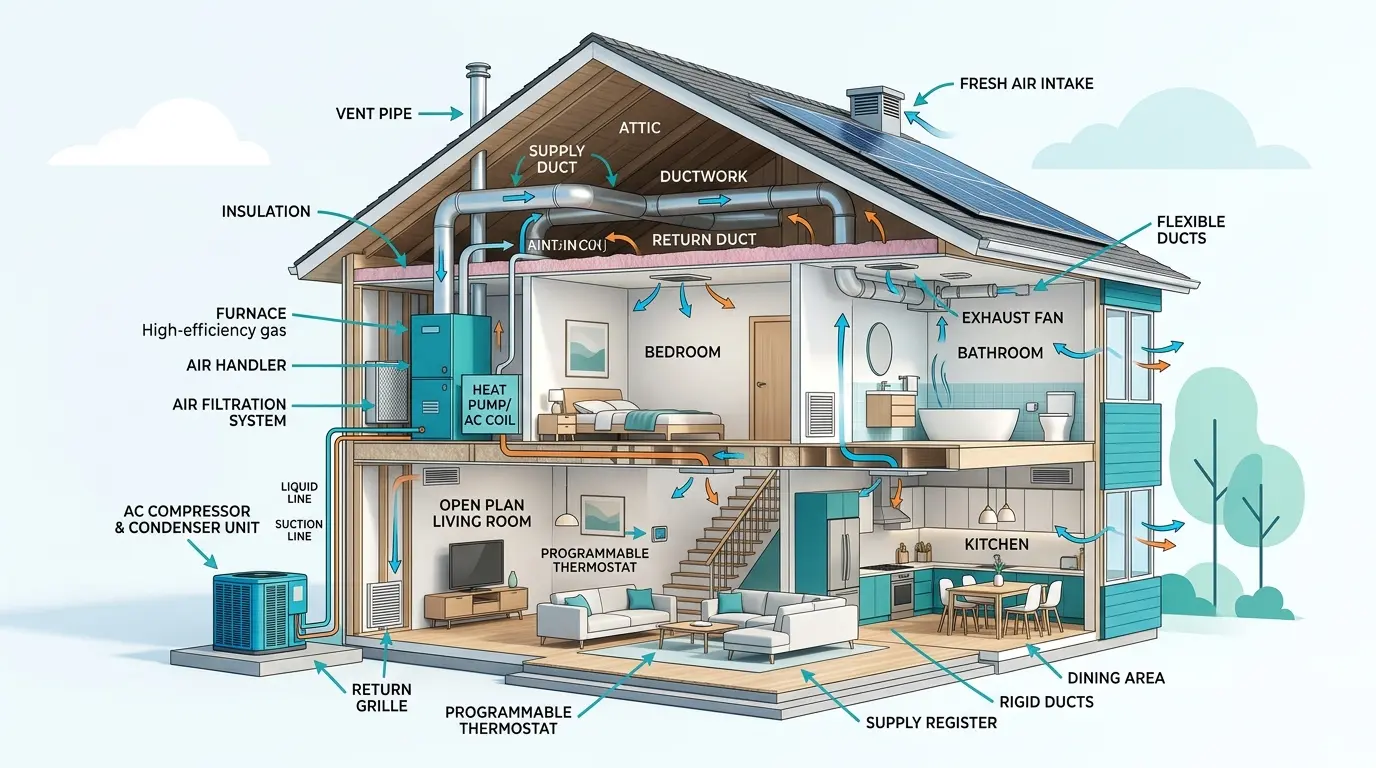
If you are asking what is an hvac system, it is a centralized or decentralized mechanical setup designed to regulate indoor temperature, humidity, and overall air quality. Standing for Heating, Ventilation, and Air Conditioning, these units manage the complete thermal and respiratory environment of a residential or commercial building. From moving warm air outdoors during July heatwaves to generating steady warmth in January freezes, this equipment operates continuously to maintain a comfortable, safe, and highly efficient indoor living space.
What Are HVAC Systems and Is HVAC Air Conditioning?
Many homeowners confuse the terminology, often asking is hvac ac or is hvac air conditioning? The direct answer is that air conditioning is just one component of the broader puzzle. When exploring what are hvac systems, you must view them as comprehensive environmental control networks. So, is hvac heating and cooling? Yes, it encompasses both functions, plus ventilation. While a/c hvac units specifically handle cooling and dehumidification by removing heat from indoor air, the complete setup includes furnaces, heat pumps, ductwork, and ventilation fans. If you want to know more about the acronym, read our guide on what does HVAC stand for.
Understanding what a hvac system does involves recognizing how it balances distinct tasks. An air conditioner might draw 3,500 watts of electricity to provide 36,000 BTUs of cooling capacity (a 3-ton system), while the gas furnace in the same network might consume 80,000 BTUs of natural gas to provide winter heating. The ventilation aspect ensures that stale indoor air is regularly swapped with fresh outdoor air, preventing the buildup of carbon dioxide, volatile organic compounds, and allergens. For a deeper dive into the mechanical process, review how does HVAC work.
What Is a Split System HVAC and What Is a Package Unit HVAC?
The most common configuration in residential properties is the split system. If you are wondering what is a split system hvac, it is a setup where the equipment is divided into two primary locations. Typically, a metal cabinet sits outside the home containing the compressor and condenser coil, while an indoor cabinet holds the evaporator coil and the air handler or furnace. This physical separation allows for quieter operation indoors since the loud compressor remains outside. According to the EPA, modern split systems can achieve seasonal energy efficiency ratios (SEER2) ranging from 14.3 to well over 22, offering significant utility savings over older 10 SEER units.
Conversely, property owners often ask what is a package unit hvac. A packaged unit consolidates all essential components, including the compressor, condenser, and evaporator, into a single steel cabinet. These are frequently installed on the roof or on a concrete slab near the foundation. Packaged units are highly favored in commercial buildings and homes with limited crawlspace or attic room. Because everything is housed together, installation is typically faster, though they may have slightly lower maximum efficiency ratings compared to top-tier split systems. Choosing between these formats heavily depends on the physical constraints of your property and you should consult a HVAC sizing guide before purchasing.
| Feature | Split System HVAC | Packaged Unit HVAC |
|---|---|---|
| Component Location | Divided indoors and outdoors | All components in one outdoor cabinet |
| Space Requirement | Requires indoor attic, closet, or basement space | Requires roof or exterior yard space only |
| Max Efficiency (SEER2) | Up to 26+ SEER2 | Typically caps around 16 to 18 SEER2 |
What Is a Heat Pump HVAC and A Coil HVAC?
As electrification trends grow, many consumers are asking what is a heat pump hvac. A heat pump is a versatile unit that provides both heating and cooling by transferring thermal energy rather than burning fossil fuels. During the summer, it acts exactly like an air conditioner by pulling heat out of the house. In the winter, a reversing valve switches the flow of refrigerant, allowing the system to extract ambient heat from the cold outdoor air and pump it indoors. High-efficiency heat pumps can operate effectively even when outdoor temperatures plummet to minus 15 degrees Fahrenheit, making them a cornerstone of modern energy-efficient building design championed by ENERGY STAR.
Inside the indoor air handler of both heat pumps and traditional air conditioners lies a crucial component. When technicians mention a coil hvac, they are referring to the evaporator coil, which is frequently shaped like the letter A (hence "A-coil"). This copper or aluminum coil holds the cold liquid refrigerant. As the blower motor pushes warm indoor air over the A-coil, the refrigerant absorbs the heat and evaporates into a gas, while condensation forms on the coil to remove humidity from the air. Regular cleaning of this coil is essential, as just one-tenth of an inch of dust can reduce system efficiency by up to 20 percent.
What Is a VAV in HVAC and What Is a Plenum HVAC?
In larger residential or commercial applications, airflow management becomes highly technical. If you are researching what is a vav in hvac, it stands for Variable Air Volume. What vav in hvac does is allow the system to vary the amount of conditioned air supplied to different zones based on current temperature demands, rather than maintaining a constant flow. By utilizing motorized dampers inside the ductwork, a VAV system can reduce fan speeds and air volumes to rooms that are already at the target temperature. This precision control drastically reduces fan motor energy consumption, sometimes by as much as 30 to 40 percent annually.
Air distribution also relies on specific ductwork junctions. People often ask what is a plenum hvac. The plenum is a large, enclosed box connecting directly to the central air handler or furnace. There are two types: the supply plenum, which pushes newly heated or cooled air into the network of distribution ducts, and the return plenum, which collects stale air from the building and feeds it back into the unit through the air filter. Proper sizing of the plenum is critical, as an undersized plenum will cause high static pressure, forcing the blower motor to work harder and potentially leading to premature mechanical failure.
What Is an ERV in HVAC and What Is an Economizer for HVAC?
Modern homes are built with tight thermal envelopes to prevent energy loss, which creates a need for mechanical ventilation. Addressing what is an erv in hvac, an Energy Recovery Ventilator is a specialized component that exchanges indoor and outdoor air while transferring heat and moisture. What ervs hvac technology achieves is the introduction of fresh air without wasting the energy used to condition the indoor air. For example, on a hot 90-degree summer day, the ERV uses the cool 72-degree indoor exhaust air to pre-cool and dehumidify the incoming fresh air. The Department of Energy (DOE) highly recommends ERVs for improving indoor air quality without skyrocketing utility bills.
Another energy-saving device is the economizer. If you are asking what is an economizer for hvac, it is a mechanical damper system integrated into the outdoor unit or ductwork that draws in cool outside air when conditions are favorable. Often called "free cooling," an economizer uses sensors to detect when the outdoor temperature and humidity are lower than the indoor levels. Instead of running the energy-intensive compressor, the system simply fans the cool outdoor air inside. This is incredibly beneficial during crisp autumn nights or mild spring days, dramatically lowering electrical consumption.
What Is a Fan Coil Unit in HVAC and What Is an HVAC System for a House?
When considering decentralized solutions, you might wonder what is a fan coil unit in hvac. A fan coil unit (FCU) is a standalone terminal device consisting of a heating or cooling coil and a fan. Unlike central systems with extensive ductwork, FCUs are placed directly in the room they serve, chilling or warming the local air using hot or cold water piped from a central boiler or chiller plant. They are extremely common in multi-family housing, hotels, and high-rise condominiums because they allow individual occupants to control their specific room temperatures independently of the rest of the building.
Finally, summarizing what is an hvac system for a house involves looking at the cohesive whole. A residential setup is a customized assembly of the technologies mentioned above, tailored to the square footage, climate zone, and insulation levels of the property. The Air Conditioning Contractors of America (ACCA) emphasizes that a properly designed residential system must undergo rigorous Manual J load calculations to ensure accurate sizing. Whether you choose a high-efficiency split system heat pump, a robust packaged gas-electric unit, or a ductless mini-split network with an ERV, the ultimate goal remains the same: delivering exact thermal comfort, pristine air filtration, and optimal energy efficiency for you and your family.
Try Our AC Sizing Calculator
Find out what capacity in tons your home requires.
Open AC Sizing Calculator →