HVAC System Lifespan: How Long Does It Really Last?
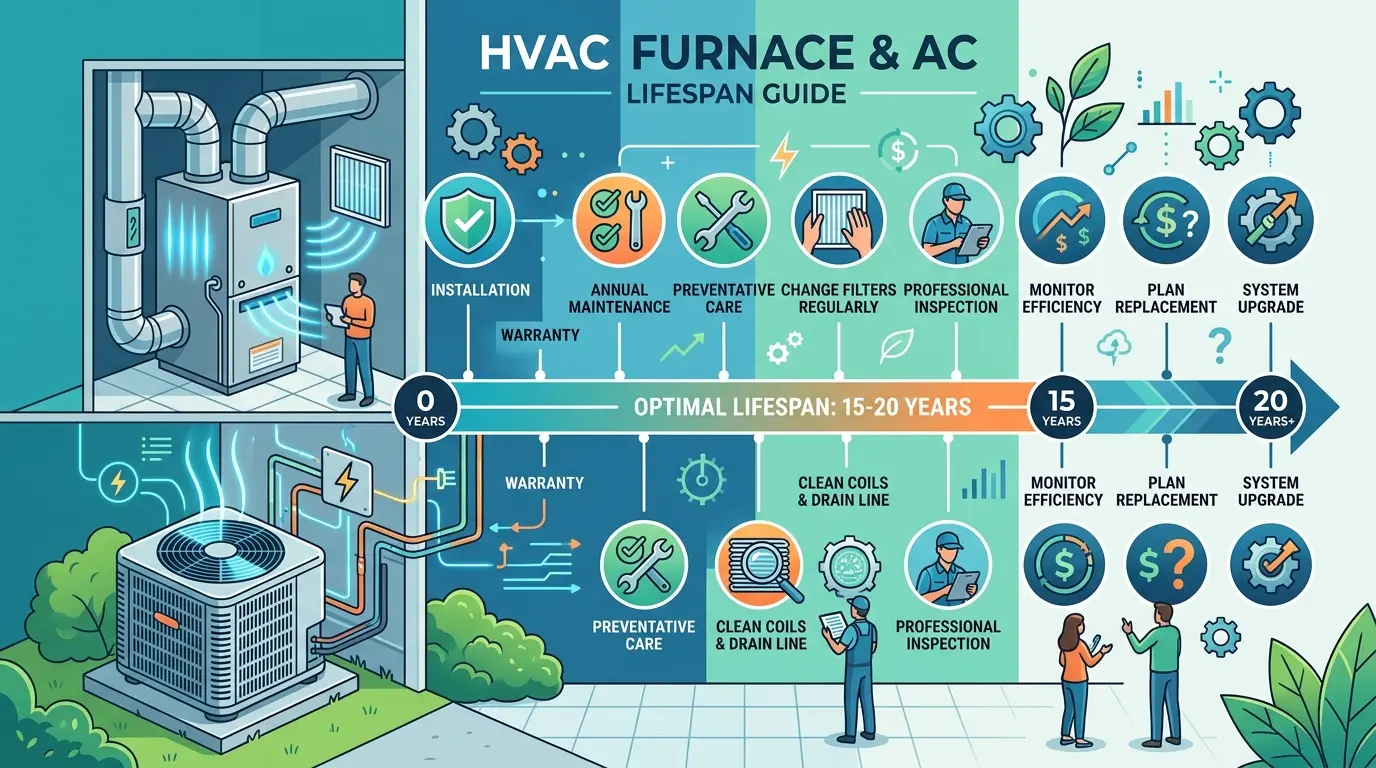
How long does an hvac system last? A standard residential heating, ventilation, and air conditioning setup typically endures for 15 to 20 years when properly maintained. Heat pumps usually operate effectively for 15 years, while high efficiency gas furnaces can operate reliably for up to 20 years. Air conditioning units fall into the 15 year range. The exact lifespan depends heavily on your local climate, usage patterns, and adherence to professional maintenance schedules according to guidelines from ENERGY STAR and the Department of Energy.
When evaluating the longevity of your home comfort equipment, understanding the distinct lifespans of each component is essential for long term financial planning. Many homeowners mistakenly believe that their entire system will fail simultaneously. In reality, the indoor heating components and the outdoor cooling components undergo different levels of wear and tear. A gas furnace located in a dry basement will often outlast an outdoor compressor exposed to rain, snow, and extreme temperature fluctuations.
How long do hvac systems last by specific component type?
To accurately assess your current equipment, we must break down the system into its primary categories. Not all heating and cooling units are created equal. The Department of Energy (DOE) provides clear baseline expectations for residential equipment longevity under normal operating conditions.
Central air conditioning units typically have a functional life of 12 to 15 years. This duration assumes the system receives annual tune ups and that the filter is changed every 30 to 90 days. Coastal areas with high salt concentrations in the air can reduce this lifespan by 3 to 5 years due to accelerated corrosion of the condenser coils.
Gas furnaces are the workhorses of winter comfort. According to data from the Environmental Protection Agency (EPA), a well maintained natural gas furnace can provide reliable heat for 15 to 20 years. Heat exchangers, the most expensive component in a furnace, are usually the limiting factor. Once the heat exchanger cracks, replacement is universally recommended for safety reasons.
Heat pumps serve double duty by providing both heating and cooling. Because they run year round in many climates, their lifespan is generally shorter than standalone furnaces. You can expect a standard air source heat pump to last approximately 15 years. Geothermal heat pumps, however, feature indoor components that can last up to 25 years and underground ground loops that are rated for 50 plus years.
Ductless mini split systems offer zoned comfort and operate with high efficiency. The indoor wall cassettes and outdoor compressors typically share a 15 to 20 year lifespan. Their longevity is often superior to traditional central systems because they lack ductwork, which can introduce dust and debris into the air handler over decades of use.
| HVAC Component Type | Average Lifespan (Years) | Key Failure Point |
|---|---|---|
| Central Air Conditioner | 12 to 15 | Compressor failure or refrigerant leak |
| Natural Gas Furnace | 15 to 20 | Cracked heat exchanger |
| Air Source Heat Pump | 12 to 15 | Reversing valve or compressor |
| Geothermal Heat Pump (Indoor) | 20 to 25 | Control board or blower motor |
| Ductless Mini Split | 15 to 20 | PC board failure |
Factors that dictate how long hvac last
Several critical variables influence the exact number of years your equipment will function efficiently. You have control over many of these factors, while others are dictated by your geographic location and the original installation quality.
Proper sizing is arguably the most critical factor determined on day one. The Air Conditioning Contractors of America (ACCA) mandates the use of Manual J load calculations to appropriately size equipment. If your unit is too large, it will short cycle. Short cycling means the compressor turns on and off rapidly, which causes massive wear on electrical components and motors. If the unit is too small, it will run continuously, leading to premature mechanical failure. A perfectly sized system runs long, steady cycles that maximize both efficiency and hardware longevity.
Preventative maintenance is the second major pillar of longevity. An annual inspection by a licensed technician ensures that moving parts are lubricated, electrical connections are tight, and refrigerant levels are exact. Running an air conditioner with a low refrigerant charge forces the compressor to work exponentially harder, often cutting its useful life in half. ENERGY.GOV strongly recommends scheduling seasonal maintenance in the spring for cooling systems and in the fall for heating systems.
Airflow restrictions are a silent killer of HVAC systems. A dirty air filter creates static pressure within the ductwork. The blower motor must then operate at maximum capacity simply to push air through the home. This leads to overheating and eventual motor burnout. Checking filters monthly and replacing them at least every 90 days is a simple habit that adds years to your system.
Environmental conditions play a massive role. Systems in extreme climates, such as the blistering heat of Arizona or the frigid winters of Minnesota, accumulate operational hours much faster than systems in temperate coastal regions. Furthermore, units installed in coastal environments face salt spray, which rapidly degrades aluminum fins and copper tubing unless factory applied protective coatings are utilized.
Financial considerations and operating costs
As an HVAC system ages, its efficiency curve drops significantly. A 15 year old air conditioner with a SEER rating of 10 might now be operating at an effective SEER of 7 or 8. Modern minimum standards set by the DOE require a SEER2 rating of at least 14.3 in northern states and 15.2 in southern states. Replacing an older, inefficient unit can yield dramatic reductions in monthly utility expenditures.
Consider a concrete numeric example. If you spend $2,000 annually on cooling costs with a 10 SEER system, upgrading to a 20 SEER high efficiency variable speed unit could reduce your cooling bills by up to 50 percent. That translates to $1,000 in annual savings. Over a new 15 year lifespan, this equipment pays for itself simply through utility cost reductions. You can learn more about comprehensive pricing by reading our HVAC system cost guide for 2026.
Tax incentives also heavily influence the replacement timeline. Under the Inflation Reduction Act, the IRS.gov provides substantial tax credits for high efficiency heat pumps and qualified central air systems. Homeowners can claim up to $2,000 annually for heat pump installations that meet specific Consortium for Energy Efficiency (CEE) tiers. Factoring in these credits changes the math from simple repair versus replace to a calculated investment in home infrastructure.
Repair costs on older systems must be weighed against their remaining life. A common industry guideline is the $5,000 rule. Multiply the age of your equipment in years by the estimated repair cost in dollars. If the total exceeds $5,000, replacing the unit is generally the wiser financial decision. For instance, a $400 repair on a 10 year old unit equals $4,000, suggesting a repair makes sense. However, an $800 repair on a 12 year old unit equals $9,600, strongly indicating that replacement is the optimal path.
Recognizing when the system is nearing the end of its life
While age is a primary indicator, your system will usually provide ample warning signs before experiencing a catastrophic failure. Frequent repairs are the most obvious symptom. If you have required professional service calls twice in the past 24 months for different issues, the internal components are cascading toward failure.
Inconsistent temperatures throughout the house indicate a loss of capacity. If certain rooms are freezing while others remain uncomfortably warm, the compressor may be losing its ability to pump refrigerant effectively, or the blower motor may be failing to generate sufficient static pressure. For a complete diagnostic checklist, review our guide on when to replace your HVAC system.
Unusual noises also serve as an early warning system. While all mechanical equipment generates sound, new grinding, squealing, or rattling noises require immediate attention. Grinding typically indicates failing motor bearings. Squealing often points to deteriorating belts in older air handlers. Rattling can suggest loose hardware or an unbalanced blower wheel. Ignoring these sounds universally leads to more expensive damage.
Rising energy bills are a quantitative metric you can track over time. If your utility rates have remained relatively stable but your consumption in kilowatt hours has spiked by 15 to 20 percent over the same month in the previous year, your equipment is running longer cycles to maintain the thermostat setpoint. This loss of efficiency is standard for aging equipment but signals that the end is near.
The impact of ductwork on system longevity
The ductwork acts as the circulatory system of your home comfort setup. Many homeowners focus entirely on the mechanical boxes while ignoring the sheet metal and flex duct hidden in their attics and crawlspaces. The Department of Energy estimates that the typical home loses 20 to 30 percent of the air moving through the duct system due to leaks, holes, and poorly connected joints.
When ductwork leaks, the equipment must run 20 to 30 percent longer to satisfy the thermostat. This additional runtime translates directly to premature wear and tear. A furnace that should run for 15 years might only last 10 years simply because it had to operate for a third more hours every single day. Sealing ductwork with mastic or professional aeroseal technology is one of the highest ROI investments for extending the life of your primary equipment.
Furthermore, poorly insulated ductwork in an unconditioned space like a 130 degree attic causes massive thermal loss. The air conditioning unit might produce 55 degree air, but by the time it travels through uninsulated ducts, it enters the living space at 65 degrees. Again, the system runs longer cycles, burns more electricity, and degrades the compressor faster. Proper R8 duct insulation is required in most modern building codes for this exact reason.
Maintenance schedules to maximize your investment
A proactive approach to maintenance is the single most effective way to ensure your system reaches the 20 year mark. We advise breaking down maintenance into homeowner tasks and professional services. Homeowner tasks are simple, inexpensive, and require no special tools.
First, maintain a clear perimeter around your outdoor condenser unit. Shrubs, tall grass, and debris restrict airflow across the condenser coil. The compressor relies on this airflow to dissipate heat removed from your home. Keep at least two feet of clearance on all sides. Second, change your filters routinely. A standard one inch pleated filter should be swapped every 30 to 45 days during peak heating and cooling seasons.
Professional maintenance requires specialized gauges, voltage meters, and EPA certifications for handling refrigerants. A certified technician will check the microfarad readings on the run capacitors. Capacitors are small cylindrical electrical components that store energy to jumpstart the motors. When a capacitor degrades, it forces the motor to pull excess amperage upon startup, causing overheating and eventual burnout. Replacing a weak 50 dollar capacitor can save a 2,000 dollar compressor.
Technicians will also clean the evaporator coil located inside the home. A layer of dust just one hundredth of an inch thick can reduce system efficiency by 5 percent. Over several years, a dirty coil can restrict airflow so severely that the coil freezes solid into a block of ice, shutting down the entire cooling process and potentially sending liquid refrigerant back to the compressor, a scenario known as slugging, which destroys the compressor instantly.
Technological advancements and future proofing
The heating and cooling industry is undergoing rapid technological shifts. When evaluating replacement timelines, consider that older R22 refrigerant has been completely phased out by the EPA. If your current system uses R22 and develops a leak, repairing it is financially unviable due to the astronomical cost of recycled R22 gas. The industry transitioned to R410A, which is now also being phased out in favor of lower global warming potential refrigerants like R454B and R32 starting in 2025.
These changing refrigerant standards mean that limping along an extremely old system might not be logical. Investing in new equipment now ensures compatibility with current service standards. Furthermore, new systems feature variable capacity compressors. Instead of running at 100 percent or 0 percent, a variable speed compressor can ramp down to 30 percent capacity, running slowly and quietly all day. This continuous operation eliminates temperature swings, dehumidifies perfectly, and drastically reduces the wear associated with startup torque.
Smart thermostats have also revolutionized equipment longevity. Modern smart thermostats use advanced algorithms to track how your home heats and cools. They can identify the optimal time to turn on the system to minimize energy use and wear. Some high end communicating thermostats can even detect fault codes within the system and alert your contractor before a complete breakdown occurs, saving you from catastrophic failure during extreme weather events.
Understanding warranties and their role in equipment lifespan
When discussing longevity, you must examine the manufacturer warranties that protect your investment. Most major brands offer a standard 5 year parts warranty out of the box. However, if you register your equipment online within 60 days of installation, that coverage typically extends to a 10 year registered parts warranty. This is a critical step that thousands of homeowners miss every year.
A 10 year parts warranty effectively guarantees that you will not have to pay for major component replacements during the first decade of operation. Note that labor is rarely covered by the manufacturer. Your local installing contractor may offer a 1 to 3 year labor warranty. After that period, if a blower motor fails in year 8, the manufacturer provides the new motor for free, but you must pay the technician for the time required to install it.
Extended labor warranties are available from third party underwriters, covering both parts and labor for 10 full years. Purchasing one of these plans essentially locks in your cost of ownership for a decade. Knowing your warranty status is essential when deciding between repairing an aging system or replacing it entirely.
The impact of local climate on wear and tear
Geographic location determines your cooling hours and heating degree days. According to the EPA, a home in Miami, Florida, will run its air conditioner for approximately 2,800 hours annually. Conversely, a home in Seattle, Washington, might only run the cooling system for 300 hours a year. Naturally, the mechanical components in the Florida home will experience fatigue at a drastically accelerated rate.
In northern climates, gas furnaces bear the brunt of the workload. A furnace in Maine will operate for thousands of hours between October and April. This constant heating cycle stresses the heat exchanger. The constant expansion and contraction of the metal eventually leads to stress fractures. Routine carbon monoxide testing by a certified professional is non negotiable in these high usage regions to ensure the exhaust gases are safely vented outdoors.
Humidity levels also affect longevity. Systems operating in the humid southeast must manage heavy latent heat loads, meaning they spend substantial energy pulling moisture out of the air. Condensate drain lines can easily become clogged with algae and mold in these regions. A clogged drain line can cause water to overflow into the furnace control board, causing an expensive electrical short. Installing a float switch on the secondary drain pan is a cheap insurance policy that shuts the system down before water damage occurs.
By taking a holistic view of your residential climate control system, from the initial ACCA approved sizing calculation to diligent seasonal maintenance, you can ensure your investment provides comfortable air for nearly two decades. Regular filter changes, prompt attention to unusual noises, and an understanding of the financial math behind repair versus replacement are the keys to a long lasting, highly efficient home.
Try Our Life Cycle Cost Calculator
Calculate the total cost of ownership including maintenance vs replacement.
Open Life Cycle Cost Calculator →