When to Replace Your HVAC System: 7 Warning Signs
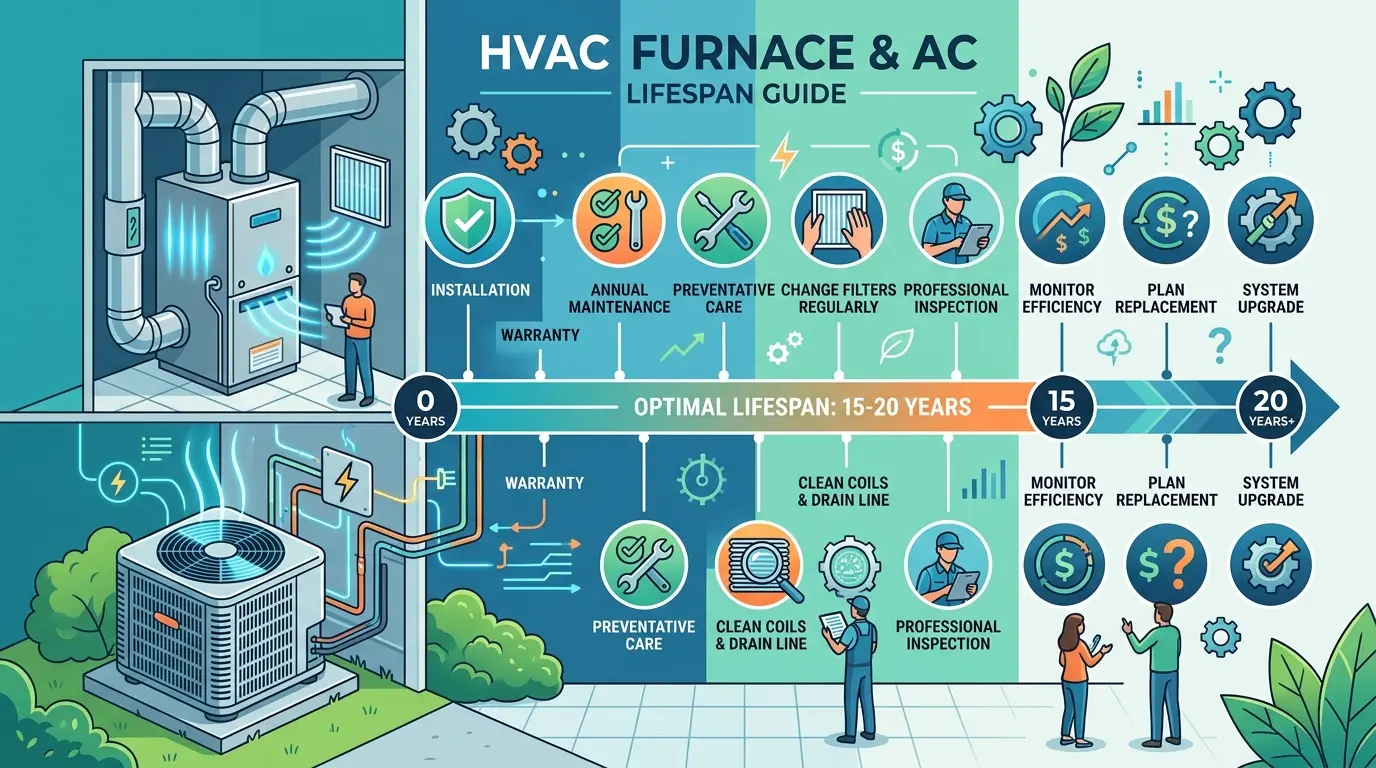
Knowing exactly when to replace hvac systems can save you thousands of dollars in emergency repairs and inflated energy costs. If your air conditioner is over 10 to 15 years old, or your furnace is approaching 15 to 20 years, you are entering the replacement window. Homeowners should consider upgrading if repair costs exceed $500 or 50% of the cost of a new unit. According to ENERGY.GOV, replacing a decade-old system with a modern high-efficiency unit can reduce energy usage by 20% to 40%.
1. The Age of Your Equipment Exceeds Industry Averages
The single most definitive factor in deciding the fate of your heating and cooling equipment is its chronological age. Central air conditioners and heat pumps generally last between 10 and 15 years. Furnaces have a slightly longer operational life of 15 to 20 years. Once your equipment crosses these thresholds, the likelihood of a catastrophic failure increases exponentially. Older systems rely on outdated technology and less efficient motors that draw more electricity. If you want to understand the exact lifecycle expectations for different components, read our comprehensive HVAC system lifespan guide. Furthermore, older air conditioning units may still use R-22 refrigerant. The EPA mandated a phaseout of R-22 due to its ozone-depleting properties. As a result, sourcing R-22 for an older leaking system is prohibitively expensive. Upgrading to a newer system ensures you are using environmentally compliant and readily available refrigerants like R-410A or R-32.
2. Your Monthly Energy Bills Are Steadily Increasing
Utility bills naturally fluctuate with the changing seasons and extreme weather events. However, a steady, unexplainable increase in your monthly electricity or natural gas costs is a major red flag indicating that your HVAC system is losing its efficiency. As internal components like blower motors, compressors, and heat exchangers wear down over the years, the system must run longer cycles and consume far more energy to produce the exact same amount of heating or cooling. According to ENERGY STAR, heating and cooling account for nearly half of a typical home energy budget. If you notice a 15% to 20% spike in your bills compared to the same month in the previous year, your equipment is likely struggling to keep up with the thermostat demands. A new system with a higher Seasonal Energy Efficiency Ratio (SEER2) or Annual Fuel Utilization Efficiency (AFUE) rating will immediately correct this excessive energy consumption and provide substantial long-term savings.
3. You Face Frequent and Costly Breakdowns
Occasional repairs are a standard part of homeownership, but you should not be on a first-name basis with your local HVAC technician. If your system requires multiple service calls per year to address frozen coils, faulty ignitors, blown capacitors, or refrigerant leaks, it is time to calculate the cumulative cost of these temporary fixes. A common rule of thumb used by HVAC professionals is the $5,000 rule. Multiply the age of your equipment by the estimated cost of the repair. If the total exceeds $5,000, replacing the unit is the financially responsible decision. For example, spending $600 to repair a 10-year-old air conditioner equals $6,000, which means replacement is highly recommended. Investing that repair money into a brand new unit provides you with a comprehensive manufacturer warranty, which usually covers parts for 10 years, eliminating the stress of unexpected financial burdens.
4. Uneven Temperatures and Poor Airflow
Your heating and cooling system should maintain a consistent and comfortable temperature in every room of your house. If you notice that your living room is freezing cold while the upstairs bedrooms are uncomfortably warm, your system is failing to distribute conditioned air properly. This uneven temperature issue often points to a failing compressor, a weakened blower motor, or an undersized unit that simply lacks the capacity to push air through your ductwork. While some airflow issues can be resolved by sealing leaky ducts or replacing restrictive air filters, persistent hot and cold spots usually indicate that the central unit is at the end of its functional life. An ACCA-certified technician can perform a Manual J load calculation to ensure your replacement unit is perfectly sized for the exact square footage and thermal envelope of your home.
5. Unusual and Persistent Noises
Modern HVAC systems are engineered to operate quietly, blending into the background of your daily life. If your equipment starts sounding like a heavy construction site, you have a severe mechanical problem. Banging or clanking sounds often mean that a loose internal part, such as a piston pin or connecting rod, is thrashing around inside the compressor. Squealing noises usually point to a deteriorating blower belt or unlubricated motor bearings. A hissing sound near the outdoor unit or the indoor evaporator coil strongly suggests a high-pressure refrigerant leak. Finally, a rattling sound could indicate a failing motor or a cracked heat exchanger. A cracked heat exchanger is particularly dangerous because it can allow deadly carbon monoxide gas to enter your living space. If your equipment is loud and disruptive, immediate replacement may be necessary for both your comfort and your physical safety.
6. Poor Indoor Air Quality and Dust Accumulation
Your HVAC system does much more than just alter the temperature of your home. It plays a critical role in filtering out airborne contaminants, allergens, and pollutants. If you notice an excessive buildup of dust on your furniture shortly after cleaning, or if your family members are experiencing an increase in allergy symptoms, asthma attacks, or respiratory irritation, your aging system is likely the culprit. Over the years, dirt, mold, and biological growth can accumulate deep within the coils and blower compartments. When the system turns on, it circulates these contaminants into every room. The EPA states that indoor air can be two to five times more polluted than outdoor air. While following a strict HVAC maintenance guide can mitigate some of these issues, a severely degraded system simply cannot filter the air effectively. Upgrading to a new unit with advanced filtration capabilities and UV light integration will dramatically improve your indoor air quality.
7. Inability to Control Indoor Humidity
A properly functioning air conditioner naturally dehumidifies the air as it cools your home. The warm indoor air passes over the freezing cold evaporator coil, causing moisture to condense and drain away outside. If you notice that your home feels muggy, sticky, or uncomfortably damp during the summer months, your air conditioner has lost its ability to extract moisture. Conversely, a failing furnace might completely strip the air of moisture in the winter, leading to dry skin, static shock, and cracking wood furniture. High indoor humidity can lead to rapid mold and mildew growth in your ductwork, walls, and basements. If your equipment is old and cannot maintain a balanced indoor relative humidity between 30% and 50%, repairing it is rarely effective. A modern variable-speed replacement system can run longer, slower cycles specifically designed to remove maximum moisture without overcooling the space.
Comparing Repair vs. Replacement Scenarios
Making the final decision requires a careful financial analysis. The table below outlines common scenarios to help you evaluate whether repairing your current equipment or investing in a brand new installation makes the most economic sense.
| Scenario | Recommended Action | Financial Reasoning |
|---|---|---|
| System is 5 years old, repair costs $300 | Repair | The unit is young and likely still under the manufacturer parts warranty. |
| System is 12 years old, compressor fails ($1,800) | Replace | The repair cost is too high for a unit nearing the end of its useful lifespan. |
| System uses R-22 refrigerant and has a leak | Replace | R-22 is obsolete and extremely expensive to source, making repairs impractical. |
| Energy bills have increased by 25% over two years | Replace | The massive drop in efficiency will cost more in utility bills than financing a new unit. |
| System is 18 years old, repair costs $200 | Replace | While the repair is cheap, a catastrophic failure is imminent due to the extreme age. |
Taking proactive steps to monitor the health of your heating and cooling equipment ensures that you will never be left stranded during an extreme weather emergency. By recognizing these seven critical warning signs early, you can plan your financial investment properly, take advantage of seasonal manufacturer rebates, and apply for tax credits offered through the DOE and IRS.gov for high-efficiency heat pump installations. Upgrading your system is a significant upfront cost, but the resulting drop in energy bills, elimination of repair fees, and dramatic improvement in total home comfort will provide incredible value for the next two decades.
Try Our Life Cycle Cost Calculator
Determine whether repairing or replacing is more cost effective.
Open Life Cycle Cost Calculator →