What Does HVAC Stand For? Complete Beginner's Guide
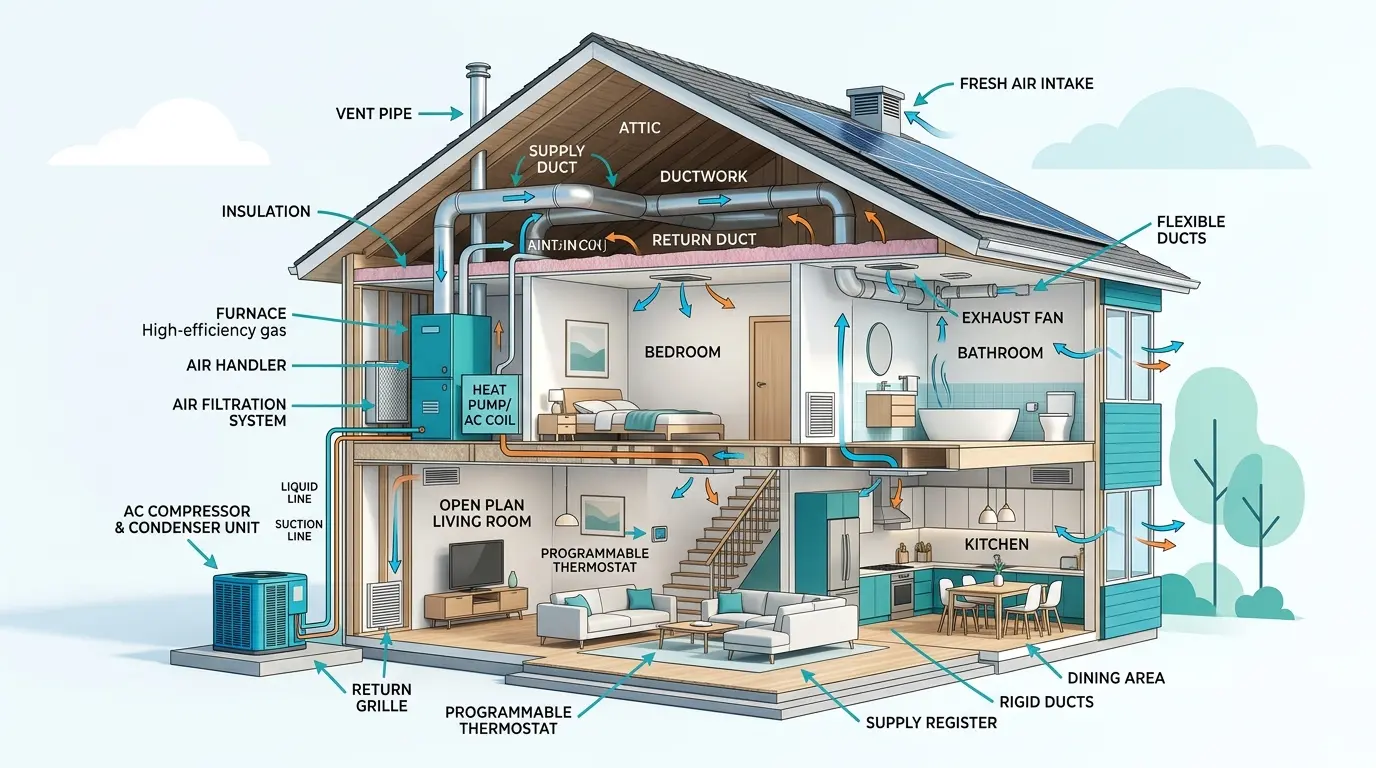
If you are wondering what does hvac stand for, the acronym stands for Heating, Ventilation, and Air Conditioning. These three interconnected functions work together to provide thermal comfort and acceptable indoor air quality in your home or commercial building. An HVAC system is responsible for keeping you warm in the winter, cool in the summer, and ensuring that fresh, filtered air constantly circulates through your living spaces.
What Does HVAC Mean?
To understand what does hvac mean, you must look at the three distinct but integrated disciplines that make up modern climate control. Heating systems increase the temperature of an enclosed space. Ventilation systems exchange indoor air with outdoor air to replenish oxygen and remove moisture, odors, smoke, heat, dust, and airborne bacteria. Air conditioning systems lower the temperature and control the humidity of the indoor air. According to the United States Department of Energy (DOE), heating and cooling account for roughly 47 percent of the energy use in a typical U.S. home, making it the largest energy expense for most homeowners. Understanding these systems is critical for managing your utility bills.
What Do You Mean By HVAC?
When contractors ask what do you mean by hvac, they are referring to the entire ecosystem of equipment, ductwork, thermostats, and electrical relays that manage a building's climate. It is not just a single box sitting outside your house. A complete system typically includes an outdoor condenser unit, an indoor air handler or furnace, a network of ductwork for distribution, and a thermostat for control. If you live in a 2000 square foot home, your system must move roughly 800 to 1200 cubic feet of air per minute (CFM) to properly condition the space. Sizing this equipment correctly requires complex load calculations based on the Air Conditioning Contractors of America (ACCA) Manual J protocols. For a deeper dive into the specific configurations, you can read our guide on HVAC System Types Explained.
What's HVAC? Component Breakdown
To answer what's hvac, we must break down the physical components that perform the work. A typical split system, which is the most common residential configuration in the United States, consists of several major parts.
- The Furnace or Air Handler: This unit sits inside your home, often in a basement, attic, or closet. It contains a blower motor that forces air through the ductwork. If it is a gas furnace, it also contains burners and a heat exchanger to warm the air.
- The Evaporator Coil: Located inside the air handler, this coil contains cold refrigerant that absorbs heat from the indoor air.
- The Condenser Unit: This is the metal cabinet located outside your home. It contains the compressor and the condenser coil, which work together to release the heat absorbed from inside your home into the outside air.
- Ductwork: The network of sheet metal, fiberglass, or flexible tubes that transports conditioned air throughout the house.
- Thermostat: The brain of the operation, communicating with the equipment to maintain your desired temperature setpoint.
What HVAC Means for Your Home's Energy Bill
Understanding what hvac means directly translates to understanding your monthly expenses. Because these systems draw significant electrical and gas loads, their efficiency ratings are strictly regulated by the Environmental Protection Agency (EPA) and the DOE. Heating systems are rated by Annual Fuel Utilization Efficiency (AFUE). A modern high efficiency gas furnace can achieve an AFUE rating of 98 percent, meaning 98 percent of the fuel is converted to usable heat, while only 2 percent escapes as exhaust. For a home spending $1,000 annually on heating, upgrading from an old 80 percent AFUE furnace to a 98 percent AFUE furnace can save approximately $183 per year.
What HVAC Stands For: Deep Dive into Heating
The "H" is a massive subject on its own. Heating can be achieved through various methods, including forced air furnaces, radiant floor heating, boilers, and heat pumps. Forced air systems use a blower to distribute heated air, while radiant systems circulate hot water through pipes in the floor. Heat pumps are unique because they do not generate heat directly. Instead, they extract ambient heat from the outside air and transfer it indoors. Even at temperatures as low as 5 degrees Fahrenheit, modern cold climate heat pumps can extract enough heat to keep a home warm. This technology has become so efficient that the IRS.gov website outlines specific tax credits under the Energy Efficient Home Improvement Credit for homeowners who install qualifying heat pumps, offering up to $2,000 in tax relief.
| Heating System Type | Typical Lifespan | Energy Source | Average Efficiency Rating |
|---|---|---|---|
| Gas Furnace | 15 to 20 Years | Natural Gas / Propane | 80% to 98% AFUE |
| Air Source Heat Pump | 10 to 15 Years | Electricity | 8.5 to 13.0 HSPF2 |
| Boiler (Radiant) | 20 to 30 Years | Gas / Oil / Electric | 85% to 95% AFUE |
What HVAC: Deep Dive into Ventilation
When people ask what hvac refers to regarding ventilation, they often overlook this crucial component. Ventilation is the process of exchanging or replacing air in any space to provide high indoor air quality. It involves temperature control, oxygen replenishment, and removal of moisture, odors, smoke, heat, dust, airborne bacteria, and carbon dioxide. Without proper ventilation, indoor pollutants can accumulate to dangerous levels. The EPA states that indoor air can be two to five times more polluted than outdoor air.
Modern homes are built with tight envelopes to prevent energy loss. While this saves money on heating and cooling, it traps stale air inside. Mechanical ventilation systems, such as Heat Recovery Ventilators (HRVs) and Energy Recovery Ventilators (ERVs), solve this problem. These devices pull fresh air in from the outside while exhausting stale air from the inside. During this exchange, they transfer heat and moisture between the two airstreams, minimizing energy loss. For a 2000 square foot home, an ERV operating at 100 CFM ensures the entire volume of air in the house is refreshed adequately without spiking the utility bills.
What's HVAC Mean: Deep Dive into Air Conditioning
Clarifying what's hvac mean requires understanding the refrigeration cycle. Air conditioners do not actually create cold air. Instead, they remove heat from indoor air. This phase conversion process relies on a chemical refrigerant. The compressor pressurizes the refrigerant gas, raising its temperature. This hot gas flows to the condenser coil outside, where a fan blows outdoor air across the coils, dissipating the heat and causing the gas to condense into a high pressure liquid. This liquid travels inside to the evaporator coil, expands into a low pressure cold gas, and absorbs heat from the indoor air blown across it. The newly cooled air is then pushed through the ductwork. To learn exactly how this cycle operates, visit our detailed explanation on How Does HVAC Work.
What's the Meaning of HVAC in Commercial vs Residential Settings
When considering what's the meaning of hvac, the scale of the application changes the equipment drastically. Residential systems usually utilize split systems as described above. Commercial buildings, however, require massive cooling capacities. A standard residential home might require a 3 ton air conditioner, which removes 36,000 British Thermal Units (BTUs) of heat per hour. A large commercial office building might require a 50 ton rooftop unit (RTU) or a complex chiller system that utilizes water instead of refrigerant to transport heat.
Commercial systems also integrate advanced building management systems (BMS) that control variable air volume (VAV) boxes. These VAV boxes adjust the amount of air delivered to specific zones based on occupancy and sunlight exposure, ensuring maximum efficiency. The maintenance protocols are also vastly different, requiring specialized commercial technicians to handle high voltage three phase power and complex pneumatic controls.
What Is the Meaning of HVAC Maintenance?
Homeowners frequently ask what is the meaning of hvac maintenance and whether it is truly necessary. The answer is a resounding yes. Regular maintenance is the only way to ensure your equipment reaches its expected lifespan and operates at peak efficiency. A neglected air conditioner loses roughly 5 percent of its efficiency every year it operates without maintenance.
A comprehensive maintenance visit should include checking the refrigerant charge, cleaning the condenser coils, inspecting the heat exchanger for cracks, lubricating moving parts, and tightening electrical connections. ENERGY STAR recommends scheduling professional maintenance twice a year: once in the spring for your cooling system and once in the fall for your heating system. Failing to change a simple $15 pleated air filter can restrict airflow so severely that the blower motor burns out, leading to a $600 repair bill.
| Maintenance Task | Frequency | Performed By |
|---|---|---|
| Replace Air Filter | Every 1 to 3 Months | Homeowner |
| Clean Condenser Coils | Annually (Spring) | Professional Technician |
| Inspect Heat Exchanger | Annually (Fall) | Professional Technician |
| Clear Condensate Drain Line | Twice a Year | Homeowner or Technician |
What Is Meant By HVAC Efficiency and Ratings?
If you are buying new equipment, you must understand what is meant by hvac efficiency. Air conditioners and heat pumps are measured by the Seasonal Energy Efficiency Ratio (SEER2). This rating calculates the cooling output during a typical cooling season divided by the total electric energy input during the same period. As of 2023, the DOE mandated new minimum SEER2 ratings across the United States. In northern states, the minimum is 13.4 SEER2 for residential central air systems. In southern states, where cooling demands are higher, the minimum is 14.3 SEER2.
Investing in higher efficiency equipment, such as an 18 SEER2 variable speed compressor, costs more upfront but provides superior humidity control and quieter operation. A variable speed compressor can ramp down its capacity to 30 percent, running continuously at a low speed. This continuous circulation filters the air more effectively and prevents the massive temperature swings associated with single stage systems that constantly turn completely on and completely off.
How Do You Pronounce HVAC?
A common question for beginners is how do you pronounce hvac. In the industry, professionals and consumers alike generally pronounce it in one of two ways. You can spell out the letters individually as H-V-A-C, or you can pronounce it as a single word: "H-vac." Both pronunciations are universally understood by contractors, suppliers, and engineers. There is no incorrect choice between the two, though saying "H-vac" is slightly faster and frequently used in casual conversation on job sites.
When Was HVAC Invented?
To appreciate modern comfort, we must look at when was hvac invented. The history spans over a century of engineering breakthroughs. While the concept of heating dates back to ancient Roman hypocaust systems, the modern air conditioning revolution began in 1902. Willis Carrier, a young engineer working at the Buffalo Forge Company, invented the first modern electrical air conditioning unit. His initial goal was not human comfort. He designed the system to solve a humidity problem at the Sackett-Wilhelms Lithographing and Publishing Company in Brooklyn, New York. High humidity was causing magazine pages to wrinkle and altering the alignment of colored inks.
Carrier's invention controlled both temperature and humidity, establishing the fundamental principles still used in refrigeration today. By the 1920s, air conditioning began appearing in movie theaters, triggering a massive boom in summer cinema attendance. Following World War II, residential window units became highly popular, and by the 1970s, central air conditioning became a standard feature in newly constructed American homes. Today, the technology has evolved to incorporate smart thermostats, artificial intelligence, and highly advanced refrigerants designed to minimize environmental impact and maximize energy efficiency.
The journey from Willis Carrier's industrial humidity controller to the whisper quiet, highly efficient variable speed heat pumps of today represents one of the most significant engineering achievements of the modern era. Proper climate control has shaped architecture, influenced population shifts to warmer climates, and dramatically improved human health by providing superior indoor air quality. By understanding the fundamentals of these systems, you can make educated decisions regarding your home comfort, energy expenditure, and environmental footprint for decades to come.
Try Our AC Sizing Calculator
Calculate the exact cooling tonnage and BTU requirement for your space.
Open AC Sizing Calculator →